

As a roofing specialist with over a decade of experience in coastal Florida, I’ve seen my share of storm aftermath. October is often a critical month for property managers. The hurricane season is winding down, and it's the first real chance to get on the roof and assess the damage. You might walk your retail property's roof in Fleming Island, notice a few things that look out of place - a loose-looking seam, a soft spot underfoot - and wonder, "Is this a simple repair, or am I looking at a bigger problem?" This is a common and important question. After a major storm, what seems minor can often be one of the key Fleming Island retail roof replacement warning signs.
Fleming Island saw significant growth during the suburban boom of the 1990s and 2000s. While this period is known for its large-scale homes with complex rooflines, it also saw the construction of numerous retail and commercial buildings to serve these new communities. Many of these buildings feature low-slope or flat roofs, and after 20-30 years of service, they are already approaching the end of their natural lifespan. A hurricane can easily push a mature roof system over the edge from needing repairs to requiring a full replacement.
Common Signs and Symptoms
After a storm passes, a visual inspection is the first step. Our technicians are trained to follow a standardized process to ensure nothing is missed. When we are evaluating a commercial low-slope roof, especially after a hurricane, we are looking for specific post-hurricane roof membrane symptoms that point toward systemic failure rather than isolated damage. Here’s what you should be looking for:
- Widespread Seam Separation: A single failed seam might be repairable. However, if you see multiple seams peeling, lifting, or separating across different areas of the roof, it’s a strong indicator that the adhesive has failed system-wide. Hurricane-force winds create negative pressure (uplift) that relentlessly pulls at these seams, and widespread failure is a classic sign a re-roof is imminent.
- Blistering or "Alligatoring": Large blisters (raised bubbles) or a cracked, crazed pattern that looks like alligator skin are signs the roof membrane itself is breaking down. This is often caused by a combination of UV exposure and age, but the stress of a storm can accelerate it, causing blisters to multiply or burst.
- Ponding Water: Flat roofs are designed with a slight slope to promote drainage. If you see significant areas of standing water 48 hours after the rain has stopped, it means you have a drainage problem. This could be due to clogged drains, but it often indicates structural sagging or crushed insulation under the membrane - a problem storms can worsen.
- Visible Membrane Uplift: Look for areas where the roof membrane appears loose, billowed, or detached from the substrate below. You may see fasteners that have pulled out or areas that look wrinkled. This is a direct result of wind uplift and is one of the most serious retail roof re-roofing signs. A detached membrane is a prime candidate for being peeled off entirely in the next major wind event.
What Causes This Problem
The primary culprit behind post-hurricane roof failure is a combination of wind uplift and water intrusion. Fleming Island’s geography makes it susceptible to prolonged periods of wind-driven rain. Unlike a simple downpour, this rain is forced horizontally, allowing it to exploit even the tiniest flaw in a roof’s defenses.
Wind uplift is the most powerful force. As high-velocity winds travel over the flat surface of a retail roof, they create a powerful vacuum effect, similar to an airplane wing. This pressure pulls upwards on the entire roof system. If the membrane is aging or the seams are already weak, the wind will find and exploit these vulnerabilities, pulling the membrane away from the insulation and deck below. This is why we often see peeling along the roof's perimeter and corners first, as these areas experience the highest wind pressures.
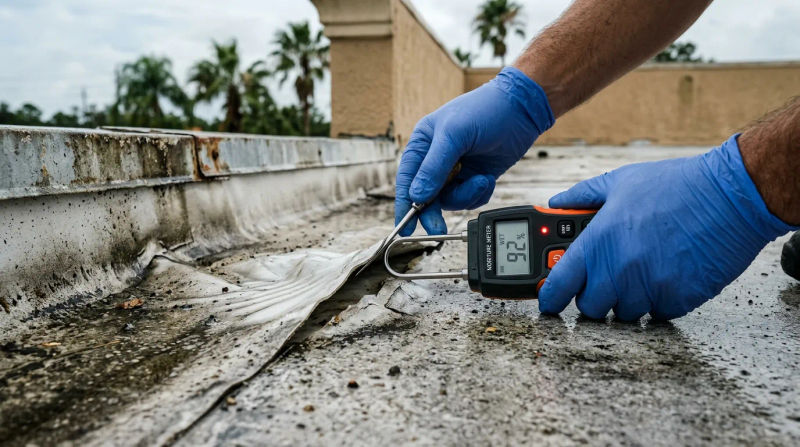
Another critical issue is roof saturation. This is a hidden danger that a simple visual check can miss. So, how to tell a flat roof is saturated? One common method our technicians use is a core sample. By cutting a small, easily repairable section from the roof, we can physically examine the layers of insulation underneath the membrane. If the insulation is damp, dark, or heavy with water, the roof is saturated. Saturated insulation loses its R-value, adds immense weight to the roof deck, and promotes the decay of the underlying structure. You might also notice soft, spongy spots as you walk the roof. This is a telltale sign the insulation below is compromised and holding water.
For buildings constructed in the 1990s-2000s, these issues are compounded by age. The materials used two or three decades ago are simply reaching the end of their effective service life. A hurricane doesn't create the problem so much as it reveals and accelerates it.
When to Call a Professional
When it comes to a commercial low-slope roof, especially after a hurricane, there is no substitute for a professional assessment. While a property manager can and should perform an initial visual inspection to spot obvious issues, a definitive diagnosis requires specialized knowledge and tools. Attempting to diagnose these issues on your own can be risky.
Walking on a storm-damaged roof can be dangerous, especially if the underlying deck is wet and compromised. Furthermore, an untrained eye can easily miss the subtle signs of widespread failure. You might see a few blisters and assume they can be patched, not realizing they are symptoms of systemic moisture trapped within the entire system.
An experienced professional will conduct a thorough inspection that goes beyond a simple walk-around. This includes:
- Core Sampling: As mentioned, this is the only definitive way to check for saturation.
- Infrared Scans: On some projects, we use infrared cameras to detect temperature differences across the roof. Wet insulation holds heat differently than dry insulation, allowing us to map out the extent of moisture intrusion without invasive cutting.
- Seam and Flashing Probing: Our crews will physically test the integrity of seams, flashing around HVAC units, vents, and parapet walls to find vulnerabilities.
Based on this comprehensive data, a qualified professional can help you understand whether targeted repairs are sufficient or if you are facing a necessary re-roof. Making this decision based on incomplete information can lead to spending money on repairs that will ultimately fail, wasting time and resources.
Conclusion
For retail property owners in Fleming Island, the post-hurricane season is a crucial time for diligence. Don't dismiss what appear to be minor issues like a few blisters or a bit of ponding water. These are often the early retail roof re-roofing signs that point to deeper, systemic problems like membrane failure and saturation. The powerful combination of wind uplift and driving rain during a storm is often the final test for an aging roof system, particularly those on commercial buildings dating back to the area's development boom in the '90s and 2000s.
Acting early is key. A thorough inspection now allows you to understand the true condition of your roof and plan accordingly. Waiting until you have an active leak inside your business is too late - at that point, you are not only dealing with a re-roof but also interior damage and potential business interruption. Protect your investment by being proactive.
If you notice any of these signs, contact a local roofing professional for a comprehensive inspection.