
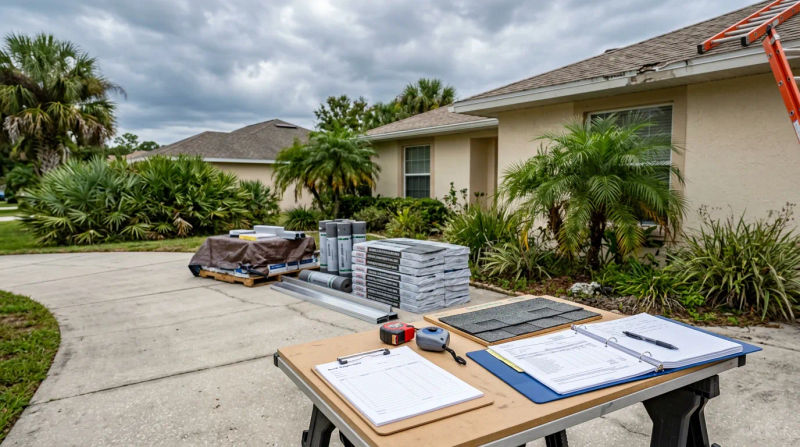
Hi, I’m Caleb Martinez. For over 12 years, I’ve been installing and repairing roofs here along the coast, from St. Augustine Beach down to Bunnell. I’ve seen firsthand what our Florida sun, salt air, and especially our hurricanes can do to a home. After a big storm passes, the immediate relief is quickly followed by a new challenge: navigating the roof insurance claim process. It’s a world filled with confusing acronyms and paperwork, and I know for many homeowners, the biggest question is, "What is this actually going to cost me?"
My goal here is to pull back the curtain on the insurance process. It’s October, and many of us are dealing with the aftermath of the storm season. Understanding how insurance payouts work is the key to budgeting correctly and getting your home secured without any financial surprises. Let’s walk through it together.
Average Costs in Bunnell
When we talk about cost in the context of an insurance claim, we’re really talking about two different numbers: the total replacement cost of the roof (the value of your claim) and your actual out-of-pocket expense (your deductible).
First, let's look at what a full roof replacement typically costs in the Bunnell area. This is the number your insurance company will be working with. For a common 1950s-era ranch home, which is typically a single-story structure around 1,500 to 2,000 square feet, you can expect these general ranges:
- Architectural Shingle Roof: A full replacement usually falls between $9,000 and $16,000. This is the most common roofing material we see and offers a great balance of durability and value.
- Metal Roof: For a standing seam metal roof, the cost is higher, typically ranging from $18,000 to $30,000+. While the upfront investment is larger, metal roofs offer superior longevity and storm resistance.
Your actual cost as a homeowner should be your deductible. If your roof replacement is approved as a covered loss, your only financial responsibility is that deductible amount. The rest is covered by your insurance settlement.
Factors That Affect Price
The final price tag - and therefore, the total value of your claim - isn't just about square footage. Several critical factors influence the scope of work and the final invoice my team sends to your insurer.
- Roof Complexity: A simple, low-pitched gable roof (like those on many post-war ranch homes) is more straightforward than a roof with steep pitches, multiple valleys, dormers, and skylights. More complexity means more labor and materials.
- Material Choice: As noted above, architectural shingles cost significantly less than premium materials like standing seam metal. Your insurance policy will typically cover replacing your roof with materials of "like kind and quality."
- Decking Condition: This is a big one, especially for homes built in the 1950s and 60s. The wood decking under your shingles is the true foundation of your roof. If a storm has lifted shingles and allowed water to penetrate, that decking can rot. We often find that the original plank or plywood decking on older homes doesn't meet modern building codes. If we find widespread damage, replacing it is non-negotiable for a secure roof, and this cost should be included in your roof insurance claim.
- Code Upgrades: Florida building codes are constantly updated to improve storm resistance. Your claim should include the cost of bringing your entire roofing system up to the current code. This might involve improved nailing patterns, secondary water barriers, or enhanced flashing techniques.
- Accessibility and Debris Removal: If your property has limited access for equipment or extensive landscaping to protect, it can add to the labor hours. The cost of removing and properly disposing of the old roofing materials is also factored in.
How to Get the Best Value
Getting the best value from your insurance claim isn’t about cutting corners; it’s about understanding the process so you receive the full amount you’re entitled to. The most important concept to grasp is ACV vs. RCV.
Most Florida homeowner’s policies are Replacement Cost Value (RCV) policies. However, the payout process happens in two stages.
- Actual Cash Value (ACV) Payment: After your claim is approved, the insurance company will send you the first check. This is the ACV. It represents the value of your damaged roof today, factoring in depreciation for its age and condition. RCV - Depreciation = ACV.
- Recoverable Depreciation: This is the second part of your payment. It’s the money held back by the insurance company until the work is completed and you provide a final invoice from your contractor. Once they have proof of the full replacement cost, they release this remaining amount.
Let's run through a Bunnell ACV vs RCV roof claim example:
- Your new roof costs $15,000 (RCV).
- Your old roof was 15 years old, so the insurer calculates $5,000 in depreciation.
- Your hurricane deductible is $2,000.
The first check you receive will be for $8,000. (That's $15,000 RCV - $5,000 Depreciation - $2,000 Deductible).
You pay your roofer your $2,000 deductible plus the $8,000 from the first insurance check. After the work is done, my team submits the final invoice for $15,000 to your insurer. They then release the $5,000 in recoverable depreciation to you, which you use to pay the remaining balance to the roofer.
It's also critical to understand your Florida roof deductible hurricane claim. Unlike a standard deductible (e.g., $1,000 for a fire), a hurricane deductible is usually a percentage of your home's total insured value, often 2% or 5%. For a $300,000 home, a 2% deductible is $6,000. Knowing this number is essential for budgeting.
Questions to Ask Your Contractor
Choosing the right partner is the most important step in this process. A good roofer acts as your advocate and guide. Here’s what you should ask:
- Do you have experience with local insurance claims? You need someone who knows the documentation and communication standards that insurers in our area expect.
- Can you walk me through my insurance adjuster's summary? A good contractor will help you understand every line item and ensure nothing was missed.
- How do you handle supplements? If we uncover hidden damage, like rotten decking, we need to file a "supplement" with the insurance company to get the additional work approved and covered. Your contractor must be proficient at this.
- How will you document the work to ensure I get my full depreciation? They should be taking photos before, during, and after, and provide clear, itemized final invoices.
- What is a typical claim timeline? For a residential roof, from claim filing to final payment, it can take several weeks to a few months. The Bunnell commercial roof claim timeline is often longer due to greater complexity, but the principles of documentation and phased payments remain the same.
Navigating a storm's aftermath is stressful enough. Understanding your insurance policy and having a trustworthy team on your side can make all the difference. The goal is to restore your home and your peace of mind, ensuring you have a safe, secure roof over your head for years to come. At Wonder Roofing & Renovations, we've helped hundreds of homeowners through this exact process.
If you're in Bunnell or the surrounding areas and need help assessing storm damage or understanding your claim, my team and I are here to help. For a personalized estimate and a clear explanation of the process, contact Wonder Roofing & Renovations for a free consultation.